
 Digytalia
Ask any electrician what eats up the most unpaid time on a job, and a good number will say the same thing: figuring out what’s actually going on inside a wall before you can even start the real work. A breaker keeps tripping, a light flickers for no obvious reason, or a homeowner mentions a burning smell they can’t quite place, and the only way to know what’s happening is to open something up. That used to mean cutting drywall, pulling ceiling tiles, or crawling into a space nobody wants to crawl into, just to confirm a hunch that might turn out to be wrong.
A borescope changes that math. Feed a slim camera probe through a knockout, an outlet opening, or a small drilled hole, and you get a live picture of the wire run, the junction box, or the conduit path without touching a single screw of finished surface. For a trade where time on site is money and every unnecessary hole is a callback waiting to happen, that’s not a gadget, it’s a way of working smarter.
The Real Value Isn’t the Camera, It’s the Decision It Lets You Make
There’s a temptation to think of a borescope as just a diagnostic toy, something that’s nice to have but not essential. In practice, it changes the order of operations on a job. Instead of cutting first and inspecting second, you inspect first and cut only where you know something needs fixing. That single change in sequence removes a huge amount of guesswork, and guesswork is where electrical jobs go over budget and over schedule.
It also changes the conversation with the client. Telling someone “I think the wiring is damaged behind this section” is very different from showing them a live feed of scorched insulation or a chewed-through cable run. Homeowners and property managers are far more willing to sign off on repair work when they’ve actually seen the problem rather than taken your word for it. That kind of visual evidence has quietly become part of how electricians justify estimates and settle disputes before they start.
Safety is the other half of the equation, and it’s easy to underrate. Reaching into a panel or a cavity blind, even briefly, carries risk that a camera simply removes. You’re not guessing where a live conductor sits or what’s sharing space with a wire you’re about to work near. The probe goes in first, your hand goes in second, and only once you know what you’re dealing with.
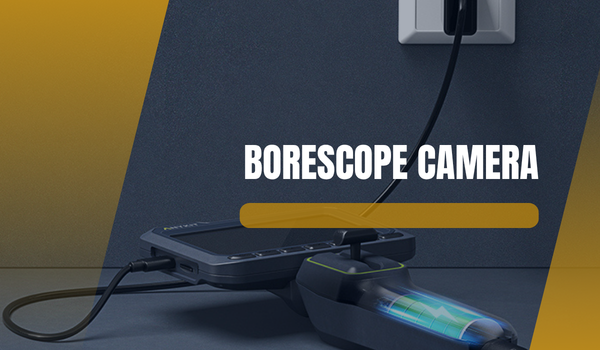
Not Every Camera Is Built for This Kind of Work
Where people sometimes go wrong is assuming any inspection camera will do. A borescope built for checking engine cylinders or plumbing lines isn’t automatically suited to electrical work, and the differences show up fast once you’re on a real job. Probe diameter determines whether the thing fits through a standard knockout at all. Cable length determines whether you’re limited to close-range checks or can trace a run through several stud bays. Screen quality determines whether you can actually tell the difference between discoloration from age and discoloration from heat damage, which matters a great deal when you’re deciding whether something needs to be replaced today or can wait.
Articulation is the feature people underestimate the most until they’ve used one that has it. Wall cavities are rarely a straight shot. There’s blocking, insulation, other trades’ work sharing the space, and wiring that doesn’t run in a convenient line. A probe that can only look straight ahead misses a lot. One that can steer around a corner or angle back toward the access point catches details a fixed camera simply won’t.
Given how much these specs vary between models, spending a bit of time on narrowing down the best borescope for electricians pays off far more than grabbing whatever inspection camera happens to be cheapest online. The gap between a tool that genuinely fits the trade and one that technically has a camera on a cable is bigger than most people expect until they’re standing in an attic trying to make one work.
The Accessories Nobody Mentions Until They Need One
Once the camera itself is sorted, the next thing that trips people up is assuming the probe alone covers every situation. It doesn’t. Electrical work has a habit of producing small, specific problems that the camera can help you find but can’t help you solve on its own. A screw drops into a junction box and disappears from view. A cable needs to be guided around an obstruction rather than just observed. A corner needs to be seen from an angle the probe can’t naturally reach.
This is where the right add-ons earn their keep. A magnetic tip retrieves dropped hardware without opening up the wall further to reach it by hand. A small hook does the same job for non-metallic debris or a cable end that’s slipped out of reach. A mirror attachment angled off the probe tip lets you see around a bend that would otherwise be a blind spot, which matters more than people expect when inspecting the inside of a box or a tight conduit elbow. None of these cost much or take up meaningful space in a tool bag, but each one turns a “we’ll have to open it up to grab that” moment into a two-minute fix.
If your current setup doesn’t include these, it’s worth checking where you can get borescope accessories that actually match your probe’s connector type, since not every attachment fits every camera without an adapter.
Building the Habit, Not Just Owning the Tool
The electricians who get the most out of a borescope aren’t necessarily the ones with the most expensive model. They’re the ones who’ve made inspecting first a routine part of the job rather than a step they reach for only when something’s already gone wrong. That habit, paired with a camera suited to the trade and a few well-chosen accessories, turns a tool that could sit unused in a drawer into something that quietly saves a job, a client relationship, or an afternoon almost every week.